Tag: European Court of Human Rights

Justice Wall A
Articles & StatementsEventsHuman Rights DefendersJustice Corner

HRS’s Justice Wall was opposite Number 10 on Human Rights Day

On Human Rights Day, HRS built a Justice Wall opposite Downing Street where supporters wrote their messages about rights abuses. Human Rights Solidarity (HRS) organised an important action on 10 December Human Rights Day. HRS activists built a 3 metre high and 15 metre long Justice Wall (made of canvas) opposite the Prime Minister’s Residence (10 Downing Street).

The top half of the wall had previously been painted by an artist depicting the persecution and rights violations of different groups in Turkey. On the lower half of the wall, which was left empty, hundreds of people who supported the protest wrote messages of justice and peace.

The Justice Wall was also unveiled during the 3rd March for Justice in front of the Council of Europe in Strasbourg on 2 October 2024 and attracted great interest from the participants. The march called on Turkey to implement the judgements of the European Court of Human Rights.

The Justice Wall on Whitehall Street, where the Prime Minister’s residence and some ministerial buildings are located, remained open from 11:00 am until 3:00 pm. During this time, hundreds of passers-by supported the action and wrote their demands and complaints about human rights on the Justice Wall.

Some of them reflected their thoughts on justice and equality on the wall by drawing striking pictures. While there were people of all ages from 7 to 70 among those who wrote messages, it was noteworthy that the expressions were written in languages other than English and Turkish, such as French, German and Arabic.

HRS also issued a statement on the occasion of Human Rights Day on 10 December. In the statement read by Ceyda Kemanci, leader of HRS Women’s Rights Committee, the 76th anniversary of the Universal Declaration of Human Rights was commemorated and it was emphasised that the continuation of wars, torture and rights violations around the world caused deep disappointment.

Stating that the Declaration proclaimed in 1948 was a great step towards securing human dignity and equality, the statement said: “However, we see that wars have not ended, torture still continues, the rights of women, children, minorities, refugees and people who think or believe differently are usurped every day. The principle of ‘everyone has equal rights from birth’ promised by the Declaration remains like a cry that does not find an echo in many corners of the world.”

The statement reminded that more than 2 million people in Turkey have been subjected to terrorism investigations on trumped-up grounds and nearly 200 thousand people have been arrested in the last 8 years, and it was stated that the decisions of the European Court of Human Rights have not been implemented. In addition, the ongoing persecution and violations in many countries such as Palestine/Gaza, China, Afghanistan, India, Iran and Yemen were explained.

The statement ended with the following statements: “Today, humanity is facing one of the most critical tests in the struggle for rights. The fundamental rights of millions of people are at stake and we should not wait for a global catastrophe to rediscover human values. We must fight together for a world where human rights are truly realised for every individual in every geography.”

human-rights-impunity
EventsHuman Rights Defenders

Impunity: An Unchanging Rule in Turkey

DATE: 26 June 2021

PLACE: YouTube

COMMITTEE: Human Rights Defenders Committee

On the occasion of the UN International Day in Support of Victims of Torture 2020, Human Rights Solidarity’s Human Rights Defenders Committee brought together experts on the mechanism of impunity in Turkey and how international legal schemes can be used to fill the vacuum. 

On 26 June 2020 we invited lawyers and human rights experts to discuss the findings of a recent report on impunity in Turkey by the Italian Federation for Human Rights (FIDU), Human Rights Defenders (HRD) and Arrested Lawyers Initiative (ALI). The report, Impunity: An Unchanging Rule in Turkey underlined that in Turkey impunity is not an aberration, but, rather, it is the norm when a rights violation is committed against individuals by state officials.

The report observed that Turkey’s impunity policy had three pillars:

  • the moral legitimization of the unlawful acts of state officials,
  • the protection provided for perpetrators by administrative and judicial authorities,
  • the legal regulations either constitute obstacles for investigation and prosecution or provide for an explicit impunity for perpetrators.

Apart from discussing the findings of the report, our panellists discussed the applicability of international mechanisms like universal jurisdiction, UN mechanism, European Court of Human Rights and the Magnitsky laws to the case of Turkey and the difficulties therein.

Our panellists were:

  • Antonio Stango, International human rights expert. President of the Italian Federation for Human Rights. Professor of Human Rights at Rome Link Campus University
  • Natacha Bracq, Human Rights Lawyer with the Paris Bar & Senior Officer for Training and Capacity Building at the International Nuremberg Principles Academy
  • Gonzalo Boye, Lawyer based in Spain, Expert on Universal Jurisdiction
  • Coskun Yorulmaz, Turkish Lawyer, London Advocacy and The Arrested Lawyers Initiative

The event was hosted by Burak Haylamaz from Human Rights Solidarity.

Outcomes of the Panel

Co-chair of Human Rights Solidarity’s Human Rights Defenders Committee Miss Esra Kalkan wrote a blog on her observations from the panel. Her “Impunity Webinar: In Turkey neither torture nor impunity are an exception anymore” can be found here. [Please put the link]

Attorney Coskun Yorulmaz’s presentation was a briefing on the findings of the report Impunity: An Unchanging Rule in Turkey. His brief can be found at our YouTube channel here: https://www.youtube.com/watch?v=g-VFQxcIFbc

Prof Antonio Stango’s speech was mainly about international mechanisms that can fill the gap of lacking domestic remedies. Prof Stango particularly delved into the UN mechanisms and the newly emerging Magnitsky laws. Prof Stango’s speech can be watched here: https://www.youtube.com/watch?v=-JSJ8RO6Y0I

Human Rights Lawyer Natacha Bracq spoke about the limits of the European Court of Human Rights and the International Criminal Court as international remedies for the victims of torture. Natacha Bracq’s presentation can be watched here: https://www.youtube.com/watch?v=pqGZG8wdm_E

Lawyer Gonzalo Boye, an expert on universal jurisdiction and somebody who had experienced torture in person brought the lessons he extracted from the Spanish case. Boye underlined that confessions taken under torture are being used against people who managed to flee the persecuting countries in extradition requests. Mr Boye’s presentation can be watched on our YouTube channel here: https://www.youtube.com/watch?v=gljEIIDYe_A

What did we learn?

Torture and impunity are global phenomena. Authoritarian regimes establish mechanisms of impunity and guarantee that victims of torture do not have access to mechanisms redress. Though there are international mechanisms, all have their own weaknesses also. European Court of Human Rights suffer from heavy workload and does not have power to impose its decisions on the states. United Nations has established several mechanisms like working groups, special rapporteurs and Universal Periodical Review, but reaching a result might take years and processes are too complicated for a victim to navigate through. Universal jurisdiction is a promising area but only if evidence of torture is preserved and some countries ask of presence of either the victim, or the alleged culprit in their jurisdictions. Magnitsky laws are promising in that they are not judicial but administrative measures and are spreading worldwide.

Human rights advocacy necessitates momentum building that can take years sometimes. We have to be realistic in our expectations from international mechanisms, but the fact that they are slow or deficient should not stop us from appealing to them.

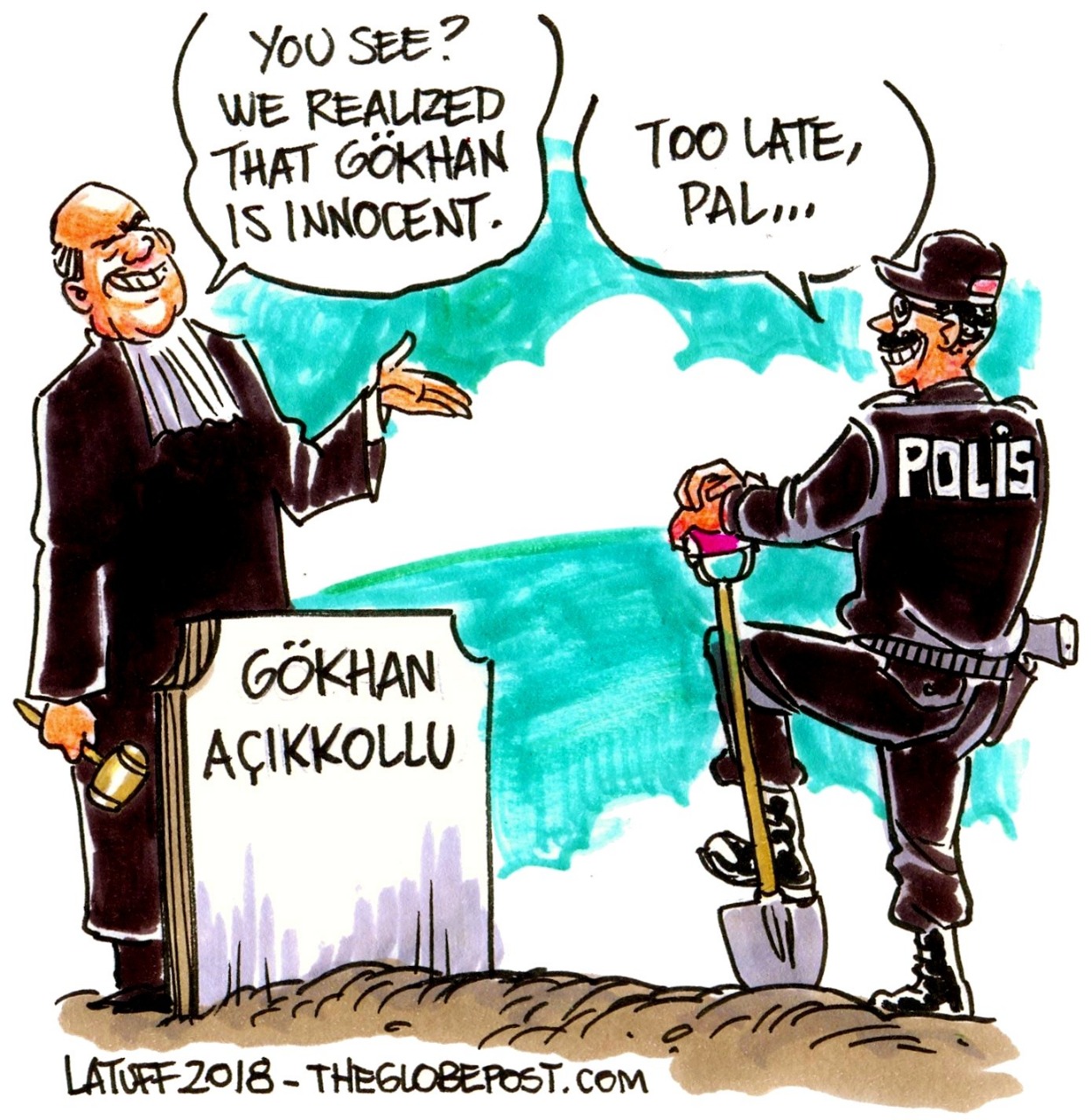
IMAGE CREDIT: Carlos Latuff/TheGlobePost.org (link to original)